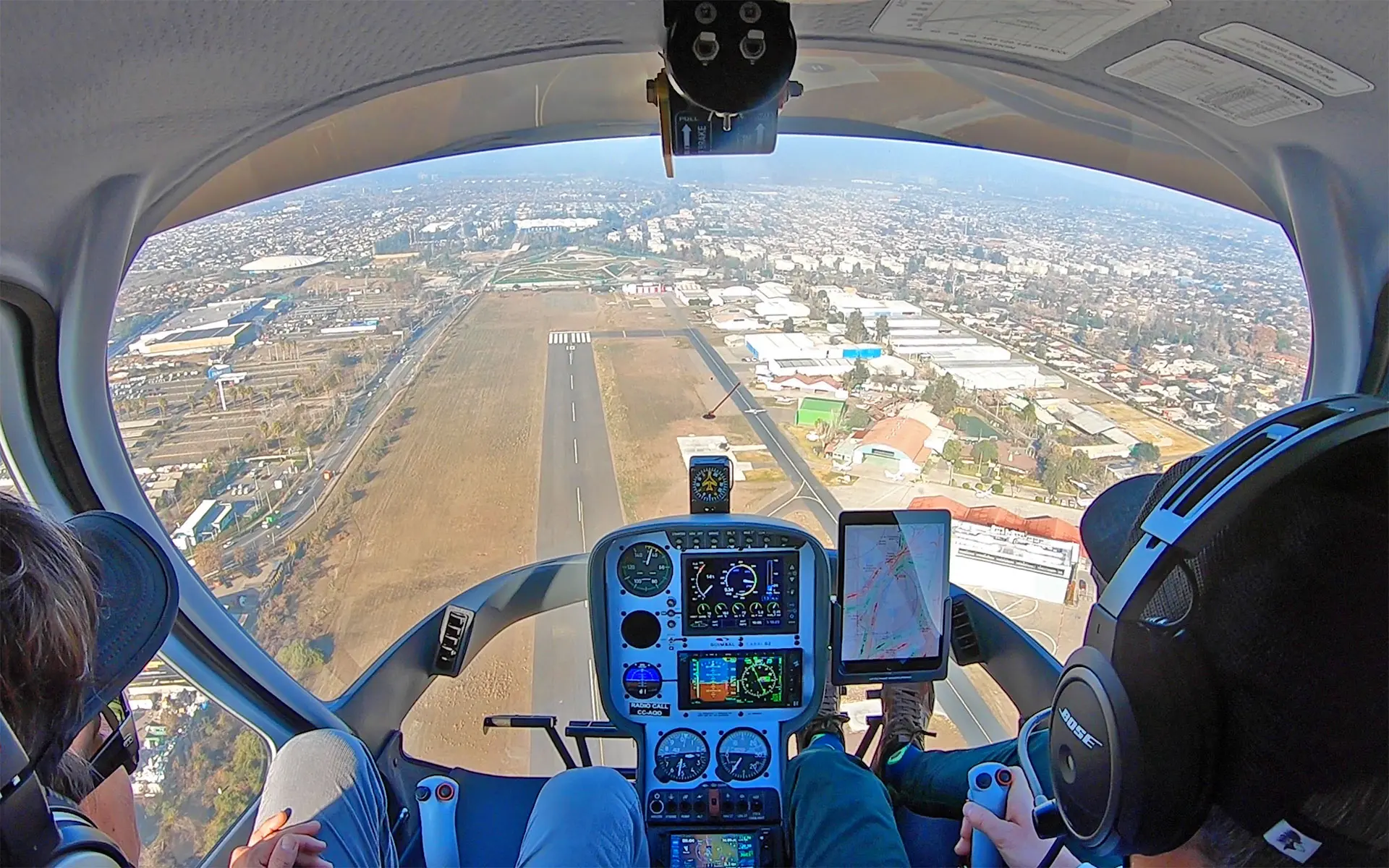
The Commercial Helicopter Pilot course is for those who want to work as helicopter pilots. In other words, a helicopter may only be flown for remuneration with a Commercial Helicopter Pilot licence.
As with the Private Pilot course, the applicant must complete a theoretical phase and a flight-training phase.
The Commercial Helicopter Pilot course is an extension of the Private Pilot course, covering the same subjects in greater depth and practising more advanced manoeuvres and flights. In short, it adds significant experience for the pilot.
This course is also designed around a personalised, friendly and flexible method, so that the student can arrange time and effort according to their availability.
The course meets the requirements set by Chile’s Directorate General of Civil Aviation (DGAC) in its specific regulations.
As for flight experience, the regulations require a minimum of 150 flight hours. The course therefore lasts approximately 3 to 4 months, but this will depend mainly on the student’s availability.
The course is flown in a Guimbal (www.guimbal.com) Cabri G2, year 2018. It is currently the best helicopter for instruction, notable above all for a modern cockpit that makes flight management easier and for a level of safety unmatched in its class.
First steps
- Take the medical examination for “Private Pilot Class 1”, through one of the following options: the private clinic CEMAE (www.cemae.cl); or Hospital FACH.
- Sign the contract and accept the conditions it sets for taking the “Commercial Helicopter Pilot” course.
- Apply on the DGAC website for the Commercial Helicopter Pilot licence.
Theoretical instruction
The Commercial Helicopter Pilot applicant must sit, at the DGAC, the 7 theoretical tests on the subjects that will be taught:
- Aerodynamics.
- Flight physiology and human factors.
- Flight instruments.
- Meteorology.
- Engines.
- Air navigation.
- Aviation regulations.
Note: the tests can and should be taken separately, so that ideally you prepare for one subject and then sit that test.
Flight instruction (practical)
The course includes the hours needed to reach the minimum experience required by the DGAC, which is 150 flight hours. The programme includes, among other things:
- Flight planning.
- Pre-flight and post-flight inspection of the aircraft.
- Radio communication.
- Basic manoeuvres.
- Cross-country flights by visual reference.
- Introduction to instrument flight (IFR).
- Advanced manoeuvres.
Flying regularly is essential to the student’s progress. Additional flight hours may, however, be needed for the student to complete the course satisfactorily.
Completing the course
To finally receive the Commercial Helicopter Pilot licence, the student must pass an oral and practical examination with a DGAC inspector.
To do so, the student must satisfactorily complete the assessments for each phase of practical instruction and pass the theoretical tests mentioned above.
Keeping flying after the course
So that the newly qualified pilot can keep flying and building experience, we offer our helicopter.
We also offer the assistance of a safety pilot for a normal flight, or a flight instructor for a training flight. That includes flight preparation, analysis of landing sites, fuel planning, weather analysis, and so on.
As an offer for students who trained with us, we include 20 additional flight hours after the course with a flight instructor or a safety pilot, at no extra charge for that service.
A commercial pilot trained by us may hire the helicopter to fly solo or with a passenger.
Fees and payment options: please enquire.